
Why I Photograph National Parks: A Kentucky Photographer's Obsession
By Scott Greenwell | Art By The Lens
There's a moment that happens in every national park — usually early in the morning, before most visitors have stirred from their campsites or hotel rooms — where the world feels entirely yours. The light is soft and low, the air carries a stillness that the middle of the day never offers, and you're standing somewhere so magnificent that your camera almost feels inadequate to the task.
That feeling is why I do this.
I'm a landscape photographer based in Prospect, Kentucky, and over the past several years I've traveled to some of the most breathtaking places in America — Grand Teton, Death Valley, Zion, Yosemite, the Oregon Coast, the Canadian Rockies — with one consistent purpose: to bring those places home. Not just for myself, but for anyone who has ever looked at a photograph of a sweeping mountain range or a star-filled sky and felt something deep and wordless stir inside them.
But my relationship with national parks didn't start glamorously. It started with a realization that I'd been missing something profound — right in my own country.
Growing Up Without the Means to Travel
I grew up in Louisville, Kentucky, in a family that didn't have the resources for big vacations. Travel wasn't really part of my childhood vocabulary. The world beyond Kentucky felt distant and abstract — something other people did.
As I moved through my career and eventually built a life that afforded more opportunities, I found myself at a crossroads that I think a lot of people reach: I had the means to travel, but I hadn't yet developed the curiosity or intention to actually do it in any meaningful way. Weekend trips here and there, but nothing that genuinely expanded my sense of what the world looked like.
Photography changed that.
I had always been interested in photography — my uncle, Gene Burch, was an accomplished landscape photographer based in Frankfort, Kentucky, and he sparked something in me early on. But it wasn't until I picked the hobby back up as an adult and started thinking seriously about where I wanted to point my lens that the national parks entered the picture.
Death Valley Changes Everything
My first national park was Death Valley, California — and if you're going to start somewhere, Death Valley is about as dramatic an introduction as the American landscape has to offer.
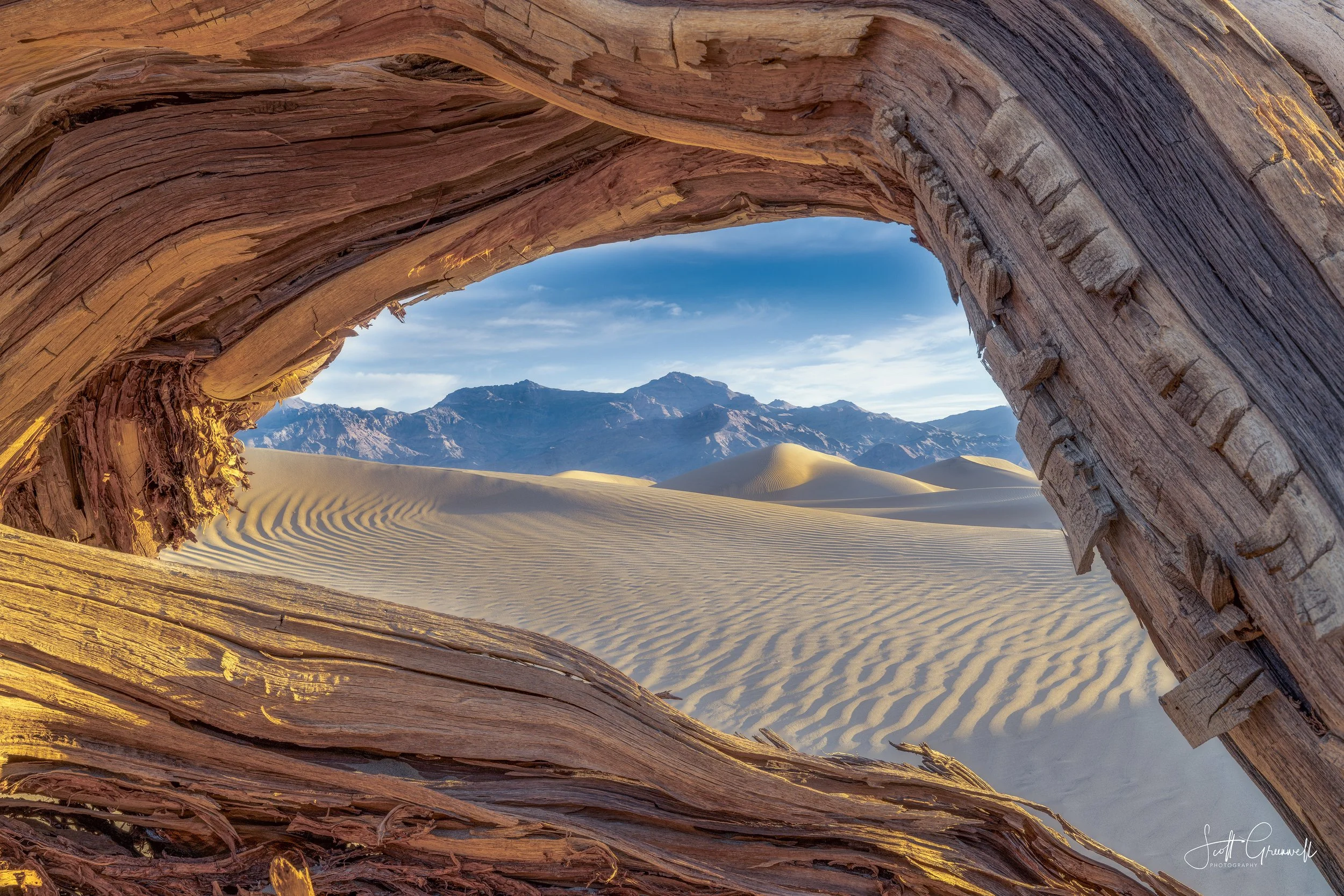
I remember arriving and feeling genuinely disoriented by the scale of it. The Mesquite Flat Sand Dunes at sunrise, when the low light carves deep shadows into the ridges of the sand and the silence is so complete you can hear your own heartbeat. Badwater Basin, the lowest point in North America, where the salt flats stretch so far in every direction that the horizon seems to curve. Dante's View, where you look down into the valley from above and try to comprehend that people actually live and travel through this otherworldly terrain.
I came home from that trip with more than photographs. I came home with a hunger.
I started researching the National Park System in earnest — its history, its scope, the extraordinary effort that went into preserving these lands for public access. What I discovered was that America has built something remarkable: nearly 430 sites protecting over 85 million acres of mountains, canyons, coastlines, deserts, and forests. An asset of almost incomprehensible scale and beauty, held in common for everyone.
That research crystallized something for me as a photographer. My goal wasn't just to capture beautiful images for their own sake. It was to share these places — to make someone who has never stood at the rim of Bryce Canyon or watched the Milky Way rise over the Watchman at Zion feel, even for a moment, like they were there.
The National Parks as a Creative Framework
What I've discovered over years of shooting in national parks is that each one demands something different from you as a photographer.
Grand Teton is about patience and precision. The Teton Range reflects perfectly in the Snake River at Oxbow Bend, but only if you're there before dawn, and only if the wind is calm, and only if the season is right. You plan obsessively, you wake at 3am, you set up in the dark — and sometimes it all comes together in a way that stops your breath.
Death Valley is about extremes. The heat, the scale, the silence. You learn to work fast in summer and luxuriously slow in winter, when the dunes glow gold at sunrise and the air is crisp and forgiving.
Zion is about intimacy within grandeur. The canyon walls are so close and so tall that the light is always dramatic, always directional. The Virgin River runs through the Narrows with a quiet persistence that feels ancient and unhurried.
Each park teaches you to see differently. And that accumulated education — in light, in patience, in the specific character of each landscape — is what I try to bring to the prints I create.
Why Fine Art Prints Matter to Me
A photograph on a phone screen is a fleeting thing. You scroll past it in seconds. But a large-format fine art print on a wall — on metal, or acrylic, or gallery canvas — is something you live with. It changes a room. It creates a focal point for a conversation. It connects the person standing in front of it to a place they may never visit in person, or a place they love and want to carry with them.
That permanence is what drives every decision I make about my work, from the moment I set up a composition in the field to the final choice of print medium for each image. I want the person who hangs one of my photographs on their wall to feel something every time they walk past it — the same wordless stirring I felt standing at the edge of Dante's View, or lying on my back in a dark field watching the Milky Way wheel overhead.
National parks make that possible. They are, without exaggeration, among the most beautiful places on earth. And as long as I'm able to travel to them and bring a camera, I'll keep trying to do them justice.
The Parks I've Photographed (So Far)
Over the years I've built galleries from some of America's most iconic landscapes, including:
Grand Teton National Park — Oxbow Bend, Snake River Overlook, Milky Way sessions, fall aspens
Zion National Park — The Watchman, Temple of Sinawava, Weeping Rock, night sky
Death Valley National Park — Mesquite Flat Dunes, Badwater Basin, Artist's Palette, Dante's View
Yosemite National Park — Valley views, waterfalls, long exposures
Bryce Canyon National Park — Hoodoos at sunrise and sunset, Inspiration Point
Yellowstone National Park — Geysers, wildlife, thermal landscapes
Grand Canyon National Park — Rim views, dramatic light, vast scale
Mount Rainier National Park — Alpine meadows, glaciers, sunset skies
Haleakalā National Park — Volcanic crater, Milky Way above the clouds
The Oregon Coast — Sea stacks, tidal pools, Milky Way over the Pacific
And closer to home, Kentucky — which deserves far more credit than it gets as a landscape photography destination. But that's a story for another post.
If you've made it this far, thank you for reading. I'd love for you to browse the national parks galleries and find an image that speaks to you — one that captures a place you've been and loved, or a place you've always dreamed of seeing. Every print ships ready to hang, and every image carries with it a piece of the morning I stood there and tried to do justice to something extraordinary.
Browse the full collection at artbythelens.com/fineart
Scott Greenwell is an award-winning fine art landscape photographer based in Prospect, Kentucky. His work is available as large-format prints on metal, acrylic, canvas, and fine art paper.