
How to Choose the Right Fine Art Print Medium for Your Home
By Scott Greenwell | Art By The Lens
You've found a photograph that stops you cold. Maybe it's a sweeping view of the Teton Range reflected in still water at dawn, or the Milky Way arching over a sea stack on the Oregon Coast. You know it belongs on your wall. But then comes the question that trips up almost every first-time fine art print buyer:
What medium should I choose?
Metal or canvas? Acrylic or luster paper? Glossy or matte? The options can feel overwhelming, especially when you're making a decision that's going to live on your wall for years — maybe decades.
I've spent years not just photographing landscapes but thinking deeply about how those images translate into physical prints. I've seen my work printed on every medium I offer, in every size, in every kind of room. So let me break this down for you in plain terms — no jargon, no pressure — just a practical guide to finding the right fit for your space and your taste.
First, Understand What You're Working With
Every print medium has a distinct personality. The same photograph can feel dramatically different depending on how it's printed and mounted. A misty forest scene that looks ethereal on canvas might feel electric and modern on metal. A vibrant sunset over Death Valley's sand dunes might look stunning in both — but for very different reasons and in very different rooms.
The key is matching the character of the print to the character of the image and the character of your space.
Here's a breakdown of every medium I offer and when each one shines.
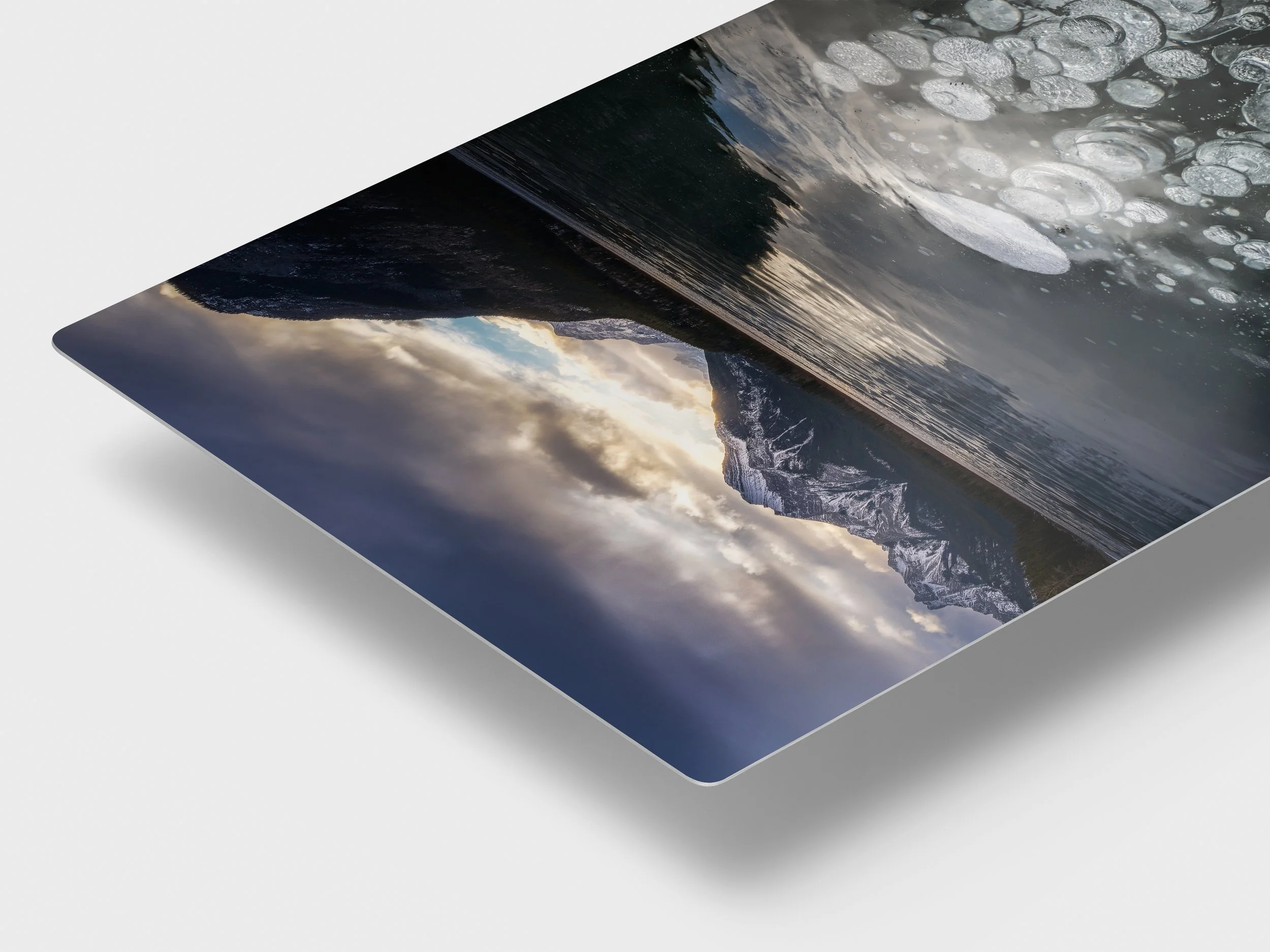
Aluminum Metal Prints
Best for: Bold, vibrant images — sunsets, Milky Way shots, colorful landscapes
The look: Aluminum prints are produced by infusing dyes directly into a specially coated metal sheet. The result is an image with exceptional color vibrancy, sharp detail, and a luminous quality that almost seems to glow — especially in images with strong light sources like the sun, moon, or stars.
The feel: Sleek and contemporary. Metal prints have clean, frameless edges and mount flush to the wall with a floating mount system that creates a subtle shadow gap. They look at home in modern, minimalist, or industrial spaces.
The practical side: Metal prints are incredibly durable — waterproof, scratch-resistant, and easy to clean. They hold up beautifully in high-traffic areas, bathrooms, or anywhere humidity might be a concern.
My recommendation: If you're drawn to my night sky work — Milky Way photographs, moonsets over the Sierras, star trails over Zion — metal is almost always the right choice. The luminosity of the medium brings those images to life in a way nothing else quite matches.
Acrylic Prints
Best for: Landscapes with rich depth, fine detail, and a gallery-quality presentation
The look: Acrylic prints are produced by face-mounting a photographic print behind a sheet of clear acrylic. The result is extraordinary depth and dimensionality — colors appear to recede and advance within the image, creating an almost three-dimensional effect. The surface has a brilliant, glass-like clarity.
The feel: Luxurious and gallery-worthy. Acrylic prints are the closest thing to seeing an image displayed in a fine art exhibition. They command attention in a room and work beautifully as a single large-scale statement piece.
The practical side: Acrylic prints are heavier than metal or canvas and require secure mounting. They're best suited for permanent wall installations rather than spaces where you frequently rearrange art.
My recommendation: For my landscape work featuring dramatic depth — canyon views, mountain reflections, layered fog over valleys — acrylic is exceptional. It's also the medium I'd recommend if you're looking for a centerpiece for a living room, executive office, or hotel lobby installation.
Gallery Wrapped Canvas
Best for: Warm, natural images — forests, flowers, soft light, earthy tones
The look: Canvas prints are produced on a textured fabric surface and stretched around a wooden frame, with the image wrapping around the edges. The texture of the canvas softens fine detail slightly and adds a painterly warmth to the image.
The feel: Classic and timeless. Canvas feels at home in traditional, rustic, farmhouse, or transitional interiors. It's the most familiar fine art print format for most people and works beautifully in living rooms, bedrooms, and dining spaces.
The practical side: Canvas is lightweight, easy to hang, and frameless by nature. It's a versatile choice that works in almost any residential setting.
My recommendation: For warmer, more intimate images — Caddo Lake's cypress trees draped in Spanish moss, Bernheim Forest in fall color, the Portland Japanese Garden — canvas tends to feel most natural. It suits images where texture and atmosphere matter more than razor-sharp technical precision.
Fine Art Paper Prints (Luster, Metallic, and Semi-Gloss)
Best for: Collectors, framed presentations, and budget-conscious buyers who want museum quality
The look: Fine art paper prints are produced on premium photographic paper in three finishes — Exhibition Luster, Glossy Metallic, and Semi-Gloss. Each has a distinct character:
Exhibition Luster has a subtle sheen that reduces glare while preserving rich color and sharp detail. It's the most versatile finish and works well framed or unframed.
Glossy Metallic has a reflective, pearlescent quality that adds depth and richness to color images — particularly effective for sunrise and sunset photography.
Semi-Gloss sits between luster and glossy, offering vibrant color with moderate glare reduction.
The feel: Traditional and refined. Paper prints are the format most associated with fine art photography exhibitions and are ideal for framing with a mat and archival glass.
The practical side: Paper prints are the most affordable option and offer the greatest flexibility in presentation — you can frame them yourself, have them custom framed, or display them in a portfolio. They're also the easiest to ship and handle.
My recommendation: If you love the idea of a framed photograph with a clean white mat — the classic gallery look — a luster or metallic paper print is the way to go. They're also a wonderful entry point if you're buying fine art photography for the first time.
How to Choose Based on Your Room
Still not sure? Here's a quick room-by-room guide:
Living room: Acrylic or large-format canvas for a statement piece. Metal for a modern space with lots of natural light.
Bedroom: Canvas for warmth and calm. Luster paper prints, framed, for a more intimate feel.
Home office: Metal or acrylic — bold, energizing images that inspire focus and creativity.
Dining room: Canvas or framed paper prints. Avoid high-gloss finishes in rooms with lots of overhead lighting, which can cause glare.
Bathroom: Metal prints only — they're the only medium fully resistant to humidity and moisture.
Commercial spaces (hotels, offices, lobbies): Large-format acrylic or metal. Both are durable, impactful, and easy to maintain.
Size Matters More Than You Think
One of the most common mistakes fine art print buyers make is going too small. A photograph that looks dramatic on a screen can feel underwhelming at 8x10 inches on a wall. As a general rule:
Small walls and accent spaces: 16x24 to 20x30 inches
Standard living room walls: 24x36 to 30x40 inches
Large or double-height walls: 40x60 inches and above
When in doubt, go larger. A print that fills a wall creates an experience. A print that's too small for its space just looks lost.
Still Not Sure? Let's Talk
Choosing fine art for your home is a personal decision, and I'm happy to help. If you have a specific space in mind — dimensions, wall color, existing furniture — reach out through the contact page and I'll give you my honest recommendation. I've helped businesses, galleries, and homeowners find the right prints for spaces of every size and style, and I take that part of the process seriously.
The right print in the right space can transform a room. I'd love to help you find it.
Browse the full Fine Art Store at artbythelens.com/fineart
Scott Greenwell is an award-winning fine art landscape photographer based in Prospect, Kentucky. His work is available as large-format prints on aluminum metal, acrylic, gallery canvas, and fine art paper.